


16/03/2026
 0 comments
The Galaxy S26 Family has just been unveiled. But before the spotlight shifts entirely to what’s new, a key question emerges for the secondary market: what happens 24 months post-launch for Samsung Galaxy S Families?
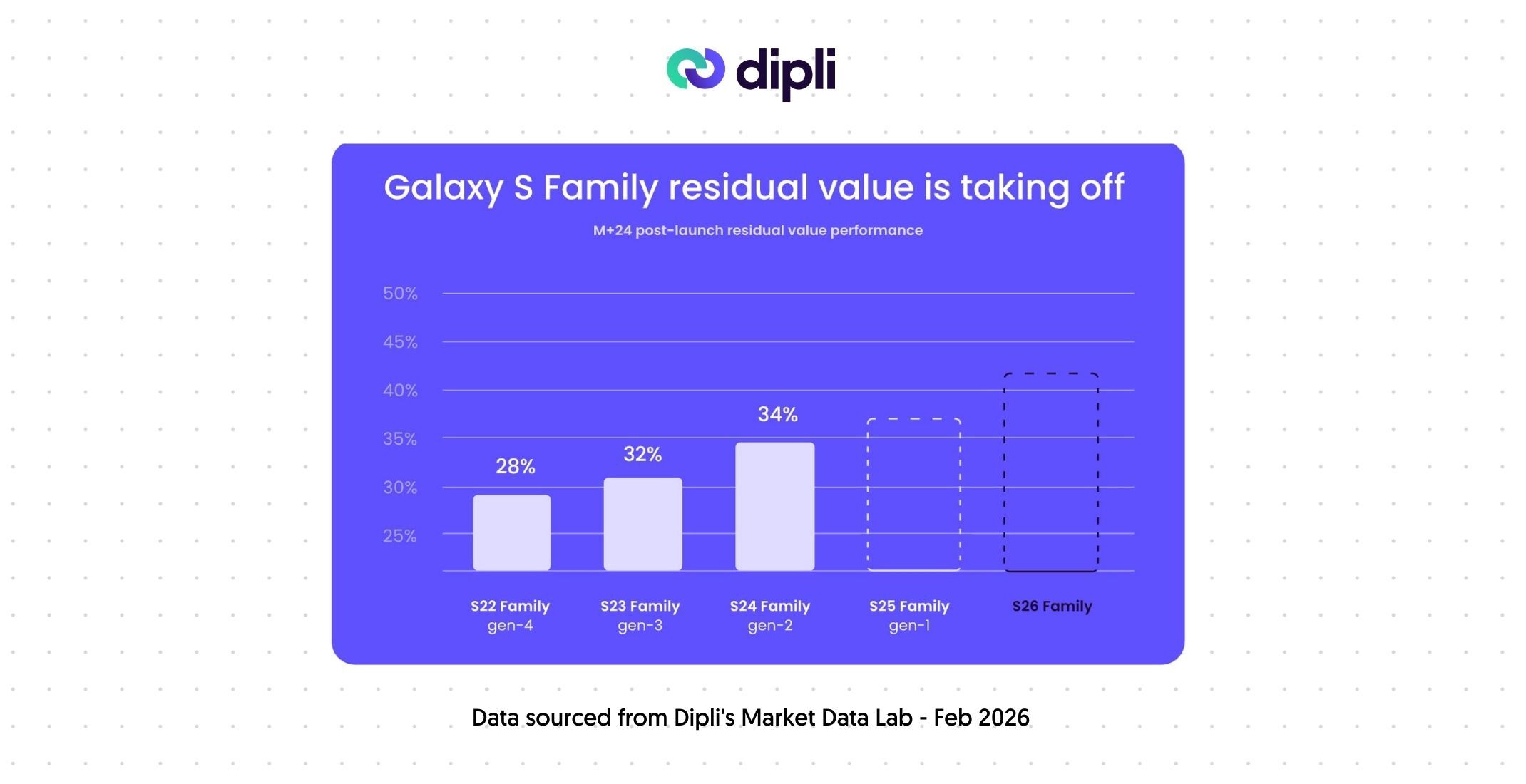
In just three generations, Galaxy S residual value at M+24 has increased by +6 points, rising from 28% for the Galaxy S22 Family to 34% for the Galaxy S24 Family, according to Dipli’s Market Data Lab.
As the Galaxy S26 generation enters the market, one question matters for the circular tech ecosystem: is the depreciation curve starting to shift?
Samsung Galaxy S Family residual value: focus on S22 to S24 at M+24
1. M+24: when upgrade cycles and trade-in volumes peak
In the smartphone lifecycle, M+24 post-launch is a decisive moment of truth. Around two years after launch, consumer upgrade cycles accelerate, triggering a surge in trade-in activity across channels.
This moment feeds the secondary market with large volumes of flagship devices, making it a critical checkpoint for the supply chain of refurbished smartphones.
👉 The quality and quantity of devices entering refurbishment channels at M+24 largely determine the availability of premium refurbished products in the following months.
💡 For the ecosystem, residual value at this stage becomes a key lever. In other words, M+24 is where the real depreciation curve of a smartphone generation reveals itself.
2. Galaxy S residual value at M+24: a +6 point improvement
Data from Dipli’s Market Data Lab shows a clear improvement in Galaxy S residual value at M+24 across recent generations:
- Galaxy S22 Family (gen -4) retains 28% of its value two years after launch,
- Galaxy S23 Family (gen -3) reaches 32%,
- Galaxy S24 Family (gen -2) climbs to 34%.
In just three generations, this represents a +6 point increase in residual value at M+24. The trend mirrors what Dipli previously observed for Galaxy S residual value at M+12, where families gained +10 points across four generations, confirming a broader strengthening of Samsung’s flagship value curve.
💡 This progression signals that Galaxy S devices are becoming stronger assets in trade-in and upgrade journeys, supporting a more stable supply of premium smartphones for the refurbished ecosystem.
Trade-in data reveals a structural shift in Galaxy S lifecycle value
1. Inside Dipli’s Market Data Lab: measuring residual value over time
These insights are powered by Dipli’s Market Data Lab, which analyzes the performance of Galaxy S Families by combining AI-driven market modelling with real trade-in transaction data collected across the market.
This approach allows us to calculate smartphone residual value at scale, generation after generation, around key lifecycle milestones such as M+12 and M+24 post-launch.
💡 By leveraging large volumes of real pricing data, the Market Data Lab provides a dynamic view of smartphone lifecycle performance. Residual value is therefore measured against actual market conditions, offering a more accurate picture of how flagship devices perform in the secondary market.
2. Will the Galaxy S25 and S26 continue bending the depreciation curve?
With the Galaxy S26 Family now entering the market, attention is already turning to how the newest generations will perform over time in the secondary market. The Galaxy S25 Family will soon approach its own M+24 milestone, a critical moment to confirm whether the upward residual value trend continues.
If the recent trajectory holds, Samsung’s flagship families could further strengthen their position in trade-in and upgrade journeys, reinforcing their value.
💡 Ultimately, the answer will come from the market itself. As new generations enter circulation, trade-in data will reveal whether Galaxy S Families continue bending the depreciation curve.
Stay tuned, Dipli’s Market Data Lab will be tracking the next residual value milestones closely on LinkedIn.

Dipli simplifies the second life of electronic products.
An all-in-one tool for distributors, leasing companies, telecom operators and companies to manage the entire value chain in one place.
The platform connects the electronics industry to secondary markets; simply and securely. Trade-in and return management, refurbishment, omni-channel purchasing and distribution: Dipli covers and simplifies all stages of the circular economy.

Comments (0)