


29/01/2026
 0 comments
The 2025 analysis provides data-driven evidence of major shifts in the secondary smartphone market, showing a sector no longer shaped only by seasonality but by deeper structural forces.
Prices continued to fluctuate in 2025, but price gaps were less frequent than last year, confirming the growing maturity and professionalization of the refurbished smartphone market.
In response to the challenges observed in 2024, industry players had to adapt quickly, seeking new solutions to stabilize supply and maintain the appeal of refurbished devices. Among these solutions, trade-in programs emerged as a key strategic lever and gained strong momentum among consumers. Other major structural drivers also shaped this unique year, including tighter European regulations, AI-driven device cycles, and telecom operators entering the trade-in market at scale.
💡 What key patterns emerged from 2025? And what do they signal for 2026? Our annual analysis draws on Dipli’s monthly 2025 price index and the latest market data to answer these questions.
2025 market metrics: understanding the forces behind secondary growth
1. Global shipment trends: how OEM leaders are reshaping supply flows
Global smartphone shipments grew +2% YoY in 2025, falling slightly short of Counterpoint Research’s initial +3.3% forecast. This slower-than-expected growth reflects uneven performance across regions, with emerging markets like Japan, Middle East and Africa, and Southeast Asia offsetting stagnation in North America and Western Europe.
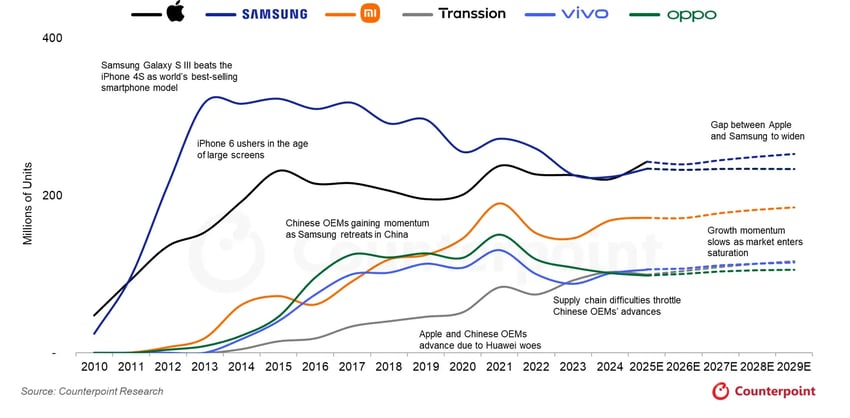 Source: "Global Smartphone Shipments: Apple vs Samsung vs Chinese OEMs, 2010-2029(E)",
Counterpoint Research Smartphone Market Monitor and Market Outlook
- Apple reached the No.1 position in global smartphone shipments for the first time since 2011.
At the top of the OEM rankings, Apple claimed a 20% global share, outperforming initial projections (19.4%). The tech giant achieved a +10% YoY shipment growth, the highest among the top five brands. Its 2025 performance was powered by a dual momentum: the successful Q4 launch of the iPhone 17 and the long tail of the iPhone 16 across India, Japan, and Southeast Asia. This wave of upgrades also coincided with the end of the COVID-era replacement cycle, injecting a significant volume of high-quality devices into both the primary and secondary markets.
- Samsung’s strong performance ranked the brand in the No. 2 position.
Samsung followed with 19% share and +5% growth — really close from what Counterpoint predicted (a global share of 18.7% and +4.6% growth) — driven primarily by the Galaxy A series in the mid-range and the Fold7/S25 in the premium tier. Despite sustained pressure in Latin America and Western Europe, Samsung maintained strong performance in Japan and its core markets.
👉 Notably, Samsung’s resurgence in the premium segment, where refurbished retention values are higher, suggests a growing pool of attractive trade-in candidates for 2026.
- Chinese OEMs, meanwhile, saw mixed results.
Xiaomi held steady at 13% share, while Oppo and Vivo each stagnated at 8%, with only modest shifts. These brands continue to dominate in volume but increasingly face margin compression and limited premium traction, impacting the value of their second-hand devices.
💡 For the secondary market, these shipment trends translate into tangible effects on refurbished stock volumes and quality mix. The dominance of Apple and Samsung in premium shipments is already reshaping trade-in pipelines and residual pricing. Refurb players can expect increased availability of high-value stock, but also greater competition and rising acquisition costs.
2. The secondary market takes the lead: volumes, value, and structural upside
In 2024, according to Houlihan Lokey, the organized second-hand smartphone market reached $38 billion globally, and Europe alone accounted for 18.5% of the global secondary market worth, reaching exactly $7 billion.
Indeed, between 2019 and 2024, refurbished smartphone shipment volumes grew 9.9% per year, while the primary market declined on an average of 3.1% YoY.
💡 In 2025, this gap widened further, confirming a structural shift: the secondary market is now outgrowing and outpacing the primary, in both units and profitability.
Behind this shift are key drivers:
- Higher consumer acceptance, fueled by price sensitivity and ESG awareness.
- Telcos and OEMs scaling up trade-in programs, creating reliable supply chains for certified refurbished stock.
- Retailers prioritizing margin-rich reconditioned devices, supported by structured logistics and localized refurb flows.
👉 For tech professionals, this means one thing: in 2026 and beyond, secondary is no longer complementary: it’s core.
3. Trade-in market focus: telcos step up, but still lag behind global leaders
2025 confirmed that telecom operators are now essential players in the secondary smartphone market, especially through the acceleration of trade-in programs. Across Europe, major telcos like Orange, Vodafone, and Giffgaff have visibly stepped up their presence with branded refurbished offers and consumer-facing campaigns.
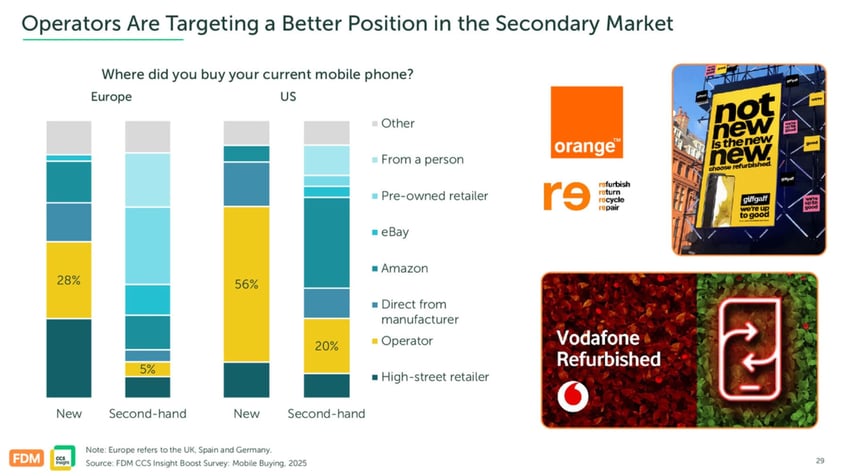 Source: FDM CCS Insight Boost Survey: Mobile Buying, 2025
In Europe, operators accounted for only 5% of second-hand smartphone purchases, far behind their role in new device distribution (28%). In the US, they captured 20% of the second-hand channel VS 56% for the new market.
The same pattern appears in trade-in performance: in 2024, the average European operator achieved just 5%, while US players reached 42%, and Japan led globally with 53%.
👉 The gap is striking, and it’s structural. In regions where operators offer streamlined trade-in and upgrade journeys, trade-in becomes a predictable, high-quality sourcing engine for the refurbished ecosystem.
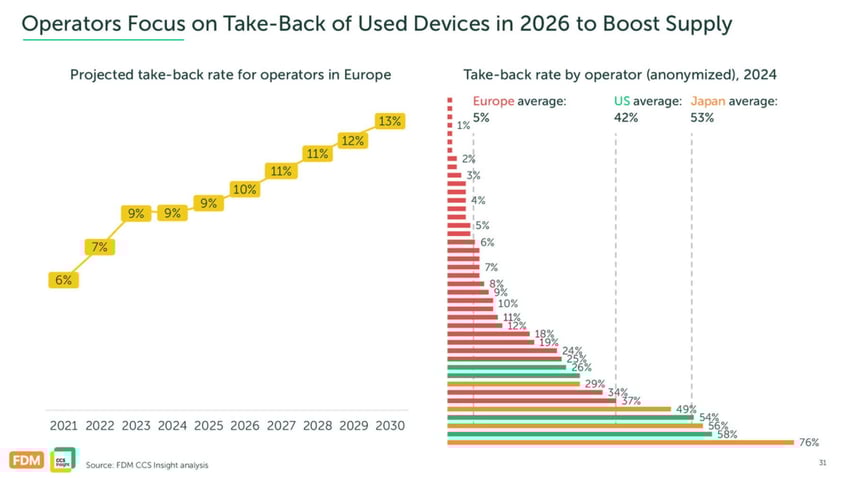
That said, progress is underway. FDM and CCS Insight forecast that European telco take-back rates will climb to 13% by 2030, with notable players already crossing the 25% threshold.
💡 The trend is clear: operators who integrate trade-in into their digital and retail strategies will control both upstream sourcing and downstream resale, increasing both margin and customer stickiness.
Check out our blog for more trade-in insights:

How prices moved in 2025: quarterly insights from our refurbished smartphones price index
1. Q1 2025: a record-breaking price drop driven by trade-in surge
The first quarter of 2025 marked one of the steepest Q1 price declines in recent years, with our index falling by 13.46 points. While this drop reflects seasonal post-holiday trends, its intensity points to deep structural shifts in the refurbished market.
- The simultaneous launches of the iPhone 16e and Galaxy S25 fueled a massive wave of trade-ins.
Samsung alone offered over €150 in trade-in bonuses, driving a rapid influx of older devices into the secondary market. This oversupply led to downward pressure on prices, particularly in Android segments.
- Beyond seasonality, the market is clearly maturing.
Despite falling prices, volumes were up +5% vs Q1 2024, showing strong demand. Retailers and operators are now operating in a high-supply, low-margin environment where precise sourcing and inventory timing are critical.

2. Q2 2025: behind the stabilization, a market in transition
Following the sharp correction of Q1, Q2 2025 brought relative price stabilization, with only slight fluctuations. While this suggests seasonal softening, it also reflects deeper structural shifts in the refurbished market.
- The absence of major flagship launches contributed to a relative stabilization.
Trade-in programs continued to flood the market, particularly with iPhone 12/13 and Galaxy S20/S21 models. However, the absence of major Q2 product launches helped stabilize prices.
- Sustainability-driven consumer behavior grew.
70% of users anow willing to pay more for eco-friendly smartphones, according to GSMA's 2025 report. This behavior helps reshaping and stabilizing refurbished demand.
💡 For market players, Q2 underscored the need for precise sourcing, localized strategies, and forward trade-in planning to protect margins and anticipate Q4 holidays shifts.

3. Q3 2025: signs of maturity as the market enters a price stabilization phase
After a volatile first half of the year, Q3 2025 marked a turning point for the European refurbished smartphone market. Prices plateaued, with minimal movement. This is the lowest intra-quarter variation observed in years, signaling growing market maturity.
- Seasonal triggers like back-to-school promotions no longer led to sharp corrections.
Instead, fine-tuned stock management, calibrated trade-in flows, and shifts toward domestic sourcing contributed to a more balanced price environment.
- Rising refurbishment costs and more price-sensitive and selective consumer base.
While global smartphone shipments slowed (+1.9% YoY vs. +4.2% expected), demand for refurbished remained stable, with players focusing more on margin optimization than volume growth.
- European regulatory framework: progressive tightening.
Regulatory changes like the EU Energy Label and the upcoming Right to Repair rules are further pushing the industry toward professionalization.

4. Q4 2025: a renewed upward trend signals a more resilient market
Q4 2025 closed the year with a strong rebound in our price index: after two months of decline, prices surged by +6.22 points in December, reaching 82.22 pts. Overall, Q4 mirrors the same price trajectory observed in 2024, confirming that year‑end dynamics are becoming predictable rather than volatile.
- Seasonal effects still exist, but price movements are smoother.
Prices during Black Friday and holiday season are better anticipated, and increasingly shaped by controlled sourcing, normalized trade‑in flows, and regulatory tailwinds favoring repairability.
- Better strategies and stronger consumer confidence, a winning combinaison.
It reflects improved sourcing strategies from major telcos, OEMs and retailers, with a stronger consumer confidence in refurbished devices. Demand remained robust, fuelled by rising new device prices and supportive European regulation around repairability and product longevity.
💡 The result: a market now entering 2026 with more predictable pricing dynamics, better margin potential, and a stronger foundation for long-term growth.
But beyond pricing, what shaped 2025? Let’s now explore the key structural dynamics of the secondary market.
Beyond prices: strategic levers reshaping the 2025 secondary market
1. The European framework: one continent, many circular markets
European regulation stepped up in 2025 with a clear push toward circularity. Since June, smartphones and tablets must display energy labels with repairability and durability ratings. This, combined with the upcoming mandatory spare parts availability in January 2026 under the “Right to Repair” initiative, is accelerating professionalization and standardization in the refurbished smartphone industry. Structured players stand to gain the most.
Yet, not all countries are advancing at the same pace. The Dipli Circular Index reveals four distinct market profiles across Europe:
🇬🇧 UK (DCI 41): circular by habit.
🇫🇷 France (DCI 37): emotionally driven, yet demanding.
🇩🇪 Germany (DCI 36): rational, price-conscious challenger.
🇵🇱 Poland (DCI 32): still emergent, but showing promise.

2. A supply-side transformation underway: trade-in is now central, but must meet consumer expectation
Trade-in has become a structural pillar of the refurbished smartphone market, feeding supply and helping stabilize prices throughout the year. Yet despite its rising strategic value, adoption remains surprisingly low. According to the Dipli x Ipsos 2025 study, 64% of Europeans have still never traded in their smartphone, revealing that the “trade-in reflex” is far from established.
To accelerate adoption, trade-in must evolve from a back-end logistics tool into a front-facing consumer service. And the rules are clear: value and simplicity win.
- For 59% of Europeans, a good price offer is the #1 factor driving trade-in satisfaction.
- 72% of users expect the trade-in process to be completed in under 30 minutes. In short, the experience needs to be quick, clear, and rewarding.
💡 Trade-in is a consumer behavior to design. Retailers, telcos, and OEMs must treat it as part of the customer journey: seamless, quick, and "good value for money"-driven. Those who succeed will be the ones who turn trade-in from an exception into a reflex.
At Dipli, these user expectations are already shaping how trade-in services are built and scaled. The key figures from 2025 down below provide valuable guidance for building an effective strategy in 2026.
- Apple accounted for nearly 80% of all trade-ins on Dipli platforms, followed by Samsung at 17.5%.
- Other brands like Xiaomi, Google, and Huawei remain marginal.
- The top 3 most traded-in smartphone models were the iPhone 13 128Go, iPhone 11 64Go and iPhone 14 128Go.
For tech professionals, the opportunity is massive, but only for those who deliver fast, fair, and frictionless experiences. In a market where trade-in is becoming a consumer habit, expertise in user journey design is the new competitive edge.
Receive the full study and uncover what’s shaping Europe’s trade-in future.

3. Residual value leadership: understanding Apple’s trade-in dominance
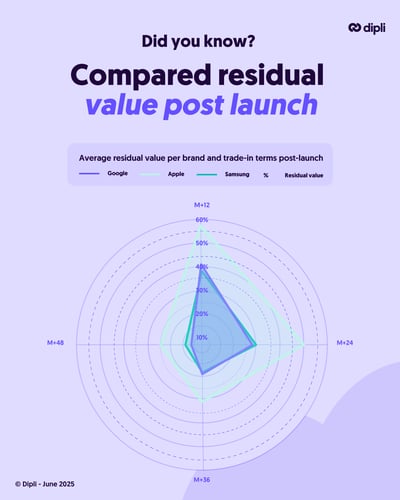
In 2025, Dipli analyzed the average device residual values of the last four generations from Apple (iPhone 11–14), Samsung (Galaxy S10–S22), and Google (Pixel 4–7). The result? A widening gap in trade-in value retention. Apple consistently outperforms its competitors:
- Apple's value retention rate that climbs to over 10 points higher than Samsung or Google 12 months post-launch.
- After 24 months, iPhone still retain 45.7% of their value, compared to 30.1% for Samsung and 28.9% for Google.
- This trend continues into years three and four, with the gap remaining at around 10% points.
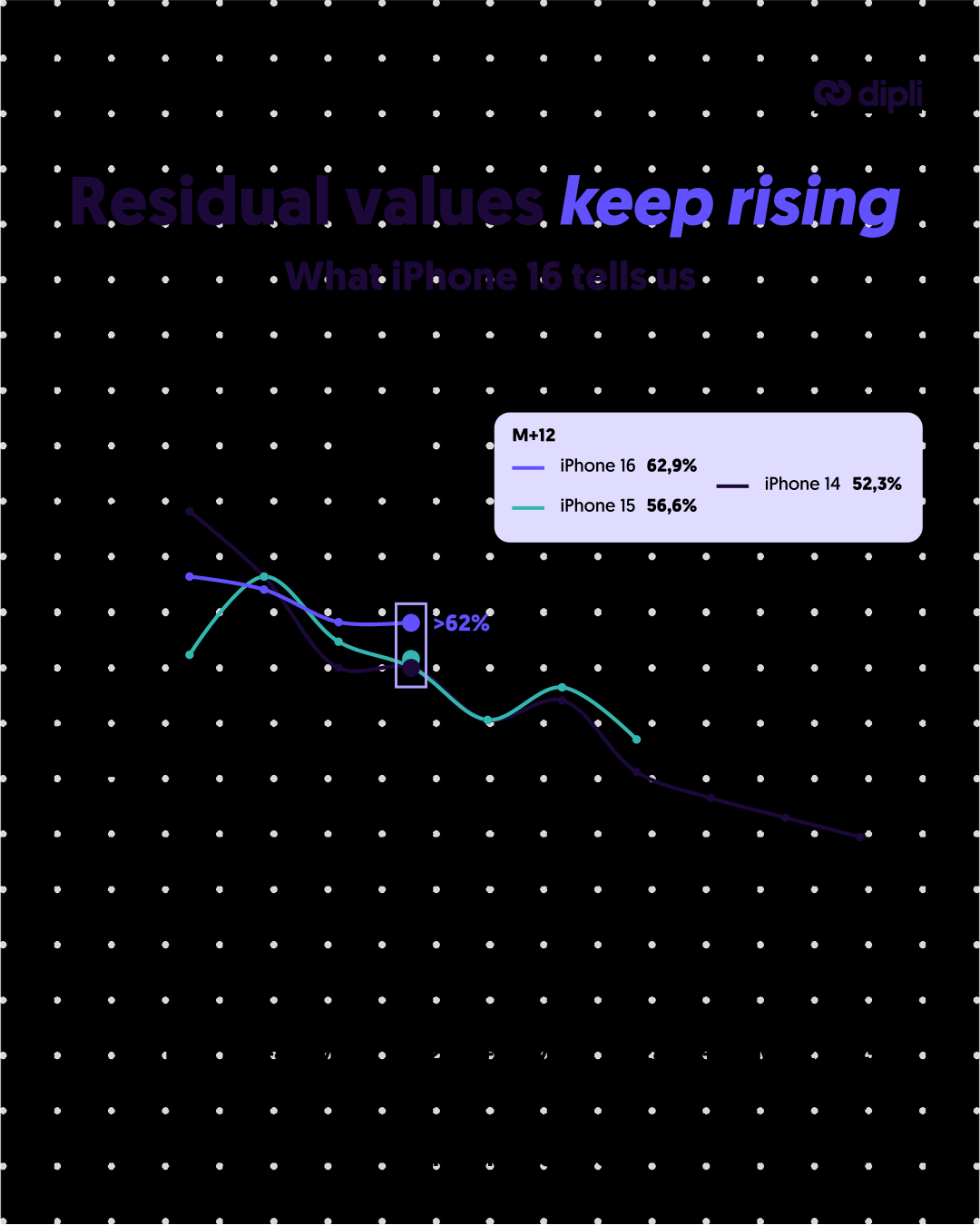
Zooming in on Apple’s latest launches, Dipli's September 2025 analysis of the iPhone 16 residual value confirms a new benchmark for the industry:
- With a 62.6% residual value at M+12, the iPhone 16 outperforms its predecessor the iPhone 15 (56.6%) and even surpasses the iPhone 14 (52.3%).
- In contrast, the Galaxy S24 (128 GB) holds only 41.9%, and the Pixel 9 trails at 34.9%.
💡 What explains Apple’s unmatched performance in residual value? Houlihan Lokey identifies three structural drivers:
-
1. New product cycles: each launch boosts trade-in supply of older models, but iPhone weather this impact better.
2. Brand strength: Apple commands loyalty and trust, reinforcing higher resale demand year after year.
3. Price positioning of new smartphone models: premium pricing perceived as too high, leading to less demand for new models and boosting residual value.
4. The refurbished market state of play
The refurbished smartphone market in 2025 continues to be shaped by clear consumer preferences, economic necessity, and evolving brand strategies.
📱 The most sold models in 2025 on dipli.com were, top down:
- iPhone 13 128GB,
- iPhone 14 128GB (SIM port),
- iPhone 12 64GB,
- iPhone 11 64GB.
These figures reflect Apple's dominance that remains unchallenged, thus both on trade-in and refurbished markets.
Notably here, the iPhone 11, which led refurbished sales for two consecutive years, now ranks fourth, signaling a gradual generational shift in consumer demand toward newer devices with better specs.
📊 This shift is reinforced by broader consumer openness to refurbished devices.
According to the Dipli x Ipsos 2025 study, two-thirds of Europeans are now open to buying refurbished, with good value for money (48%) and long-term guarantees (42%) as the top drivers. Interestingly, ecological impact trails at just 15%, showing that economic logic still outweighs environmental concern in purchasing decisions.
The context surrounding new devices continues to strengthen refurbished adoption. In fact, the rising cost of new smartphones, driven by more expensive components like processors and memory, has further widened the affordability gap, making refurbished purchases a rational, high-value choice rather than a compromise.
💡 Altogether, these trends point to a structurally solid and demand-driven refurbished market, where affordability, reliability, and generational turnover converge to define the consumer offer.
2026 outlook: the secondary market at an inflection point
1. The AI wave is flooding the smartphone markets
In 2025, 41% of global smartphones shipped were AI-capable, and this figure will reach over 65% by 2027 (FDM x CCS Insight). AI is reshaping both new smartphone shipments and the secondary value chain.
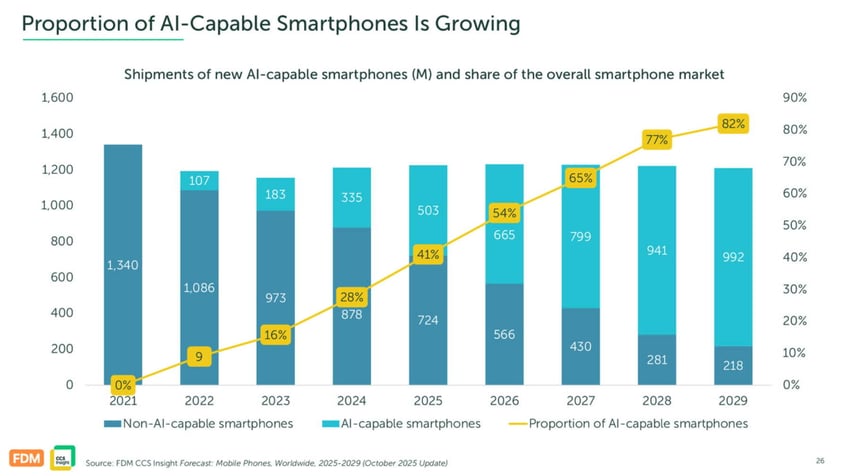 Source: FDM CCS Insight Forecast: Mobile Phones, Worldwide, 2025-2029 (October 2025 Update)
AI also transforms the trade-in and refurbishment ecosystems. Across Europe and North America, automated trade-in kiosks and software-first diagnostic tools are rapidly scaling. Players like Dipli, Get-RE and Pandas are enabling instant valuation, consistent grading, and lower processing friction. At the backend, automation now powers diagnostics, testing, and data wiping.
💡 The growing presence of AI-centric hardware increases device complexity and value retention: key factors that will affect grading, resale, and sourcing in the coming years. In parallel, AI-centric software are emerging for scalable, standardized, and margin-efficient secondary market operations.
2. But AI drives memory shortages, and the impact is already hitting the market
The AI boom comes at a cost, and the memory market is the first to feel it. In late 2025, memory prices (DRAM/NAND) began rising sharply as you can see on the chart down below. As chipmakers redirect production toward AI-optimized memory (HBM) for data centers, shortages are emerging across consumer electronics.
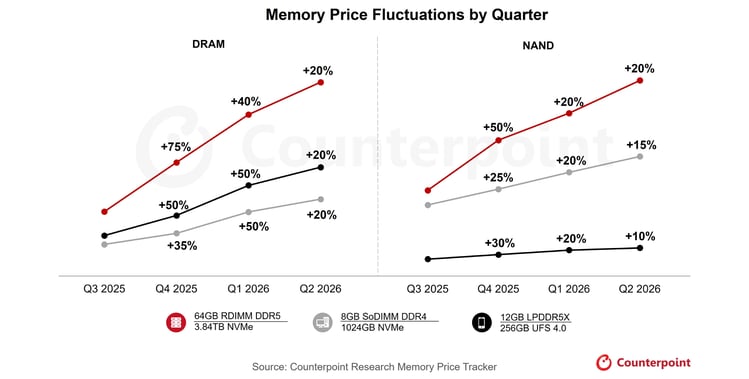
Source: Counterpoint Research Memory Price Tracker
According to IDC, this tension is already reshaping 2026 forecasts:
- ASPs are expected to rise by +3 to +8%,
- Memory makes up 15–20% of a mid-range smartphone’s cost and 10–15% for high-end models. As prices surge, OEMs may be forced to raise prices, lower specs, or both.
Source: Global Memory Shortage Crisis: Market Analysis and the Potential Impact on the Smartphone and PC Markets in 2026
💡 For the refurbished market, this creates a dual effect: longer replacement cycles and fewer volumes entering the secondary stream, especially at the low end. At the same time, residual values are set to rise, particularly for high-spec models, amid tighter availability.
👉 In short, the race for AI dominance is reshaping both the cost structure of new smartphones and the sourcing dynamics of the refurbished market, with effects likely to last through 2027–2028.
3. European regulation: long-term tailwinds
Together, these measures are pushing the entire industry toward standardization, transparency, and circularity, benefiting structured players in the long run:
- USB-C becomes the new standard across all smartphones sold in the EU from 2025, simplifying accessories and boosting compatibility.
- The Digital Product Passport, set to launch progressively, will bring greater transparency on repairability, origin, and lifecycle data.
- The “Right to Repair” directive takes a step further in January 2026 with mandatory spare parts availability, aimed at extending product life.
- Since June 2025, smartphones must display the EU Energy Label, including repairability and durability scores, encouraging more informed and sustainable purchases.
4. OEM strategies: new plays in the refurbished segment for Apple and Samsung
- Samsung scales its Premium Refurbished Program.
After initial rollouts in South Korea and the U.S., Samsung is now expanding its Premium Refurbished offer to France, Germany, and the UK. Devices are sold at a lower price point, but with no compromise on performance, quality, or warranty, signaling the brand’s strategic entry into the certified pre-owned space.
- Apple foldable rumors gain traction.
While foldables account for under 2% of the total smartphone market today, they are expected to hit 10% of the premium segment (>€800) by 2028 (Source: Source: Counterpoint Research, Counterpoint Quaterly Smartphones Q3 2025, October 2025). Momentum could accelerate as Apple is rumored to enter the category in 2026, a move that could redefine both the new and secondary markets.
Conclusion: OEMs, telcos and retailers need to move trategically in a stabilized, competitive market
2025 confirmed a major structural shift in the secondary smartphone market: from reactive pricing to proactive supply management. Retailers and telcos have begun to anticipate trade-in flows, enabling greater stock control and smoother price cycles throughout the year. The rise of AI, new regulations, and tech giants scaling refurbished initiatives all contribute to a more competitive but predictable landscape.
- For retailers, this new normal means more room to optimize margin, but only for those who secure inventory ahead of seasonal peaks and align sourcing with market demand.
- For telecom operators, the rise of trade-in as a supply engine must be matched with commercial ambition. Despite progress in 2025, telcos still lack real leadership in Europe’s second-hand market. Now is the time to scale programs, structure offers, and claim long-term market share.
- For OEMs, the expansion of official refurbished channels (as seen with Samsung) and potential product shifts (e.g. foldables from Apple) show that the secondary market is no longer a side business: it's part of the core ecosystem.
💡 2026 will reward those who operate with precision, anticipate trends, and treat trade-in and refurbishment as strategic growth pillars, not backup channels.
Dipli simplifies the second life of electronic products.
An all-in-one tool for distributors, leasing companies, telecom operators and companies to manage the entire value chain in one place.
The platform connects the electronics industry to secondary markets; simply and securely. Trade-in and return management, refurbishment, omni-channel purchasing and distribution: Dipli covers and simplifies all stages of the circular economy.

Comments (0)